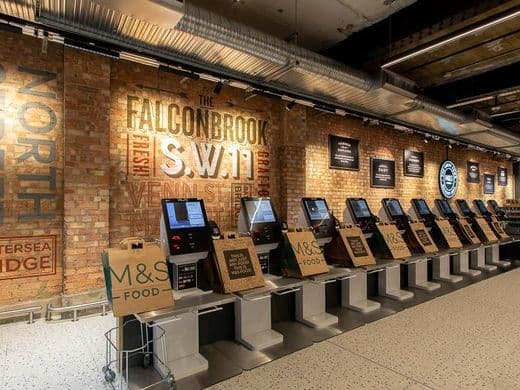
If you live somewhere like Clapham, you're not going to be short of options. Tesco, Sainsbury's, Lidl, Waitrose, M&S, and Asda are all genuinely accessible, most within walking distance of each other. Every one of them has a loyalty scheme, an app, and a pitch for why you should keep coming back.
So we decided to put them to the test. We built a comparable weekly basket of 13 everyday items, from eggs and milk to sourdough and toilet roll, and took it to all six. We compared what we paid, what the loyalty scheme actually did to the spend, and what came back afterwards in the form of points, vouchers, perks, and rewards.
But the more interesting question wasn't really about the numbers. It was this: in a place where every option is available, which loyalty scheme actually gives you a reason to remain a loyal customer?
The Basket — what did it actually cost us?
Before any loyalty magic, what are we actually paying?
We kept the basket as comparable as possible: own brand where we could, same quantities, same product types. That said, perfect like-for-like is impossible. Waitrose's chicken is slow-reared, and M&S sells cheddar in 350g blocks instead of 400g. These retailers are selling different propositions, not just different prices, and as a shopper, the question is really about what you're happy to treat as substitutable.
Here's the basket breakdown:
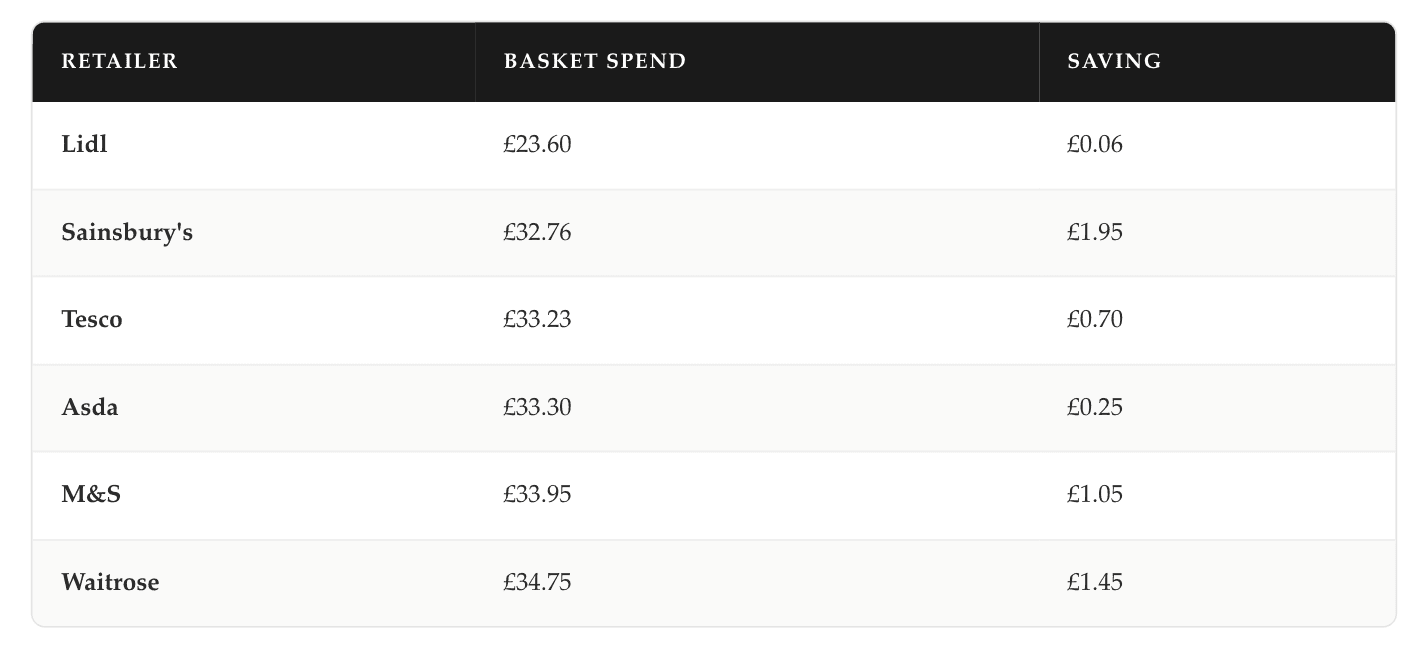
Lidl is in a different league on base price, the equivalent of saving the cost of an entire weekly shop every month or so just by choosing Lidl. At the other end, Waitrose and M&S are noticeably more premium: slow-reared chicken, native breed beef, higher product specs and higher-quality own-brand packaging across the board. Tesco, Sainsbury's and Asda cluster in the middle, broadly similar on a generic basket.
So where did loyalty actually show up?
Not all of these schemes are designed to move the needle on a normal weekly shop. Clubcard and Nectar are the clearest examples of schemes that directly change basket economics, with member prices showing up on specific items, knocking the price down at the till in a way that's visible and immediate. On top of that, both generate points that translate into future value.
Lidl Plus didn't directly change item prices in this basket, partly because none of the current offers coincided with what we were buying. The scheme is more about app-activated coupons, spend thresholds and free items (bakery, fresh fruit) than broad basket pricing, so its impact is less predictable on any given shop but not absent over time.
Waitrose and M&S had some marked-down items, but these felt more like standard retail promotions than loyalty-driven mechanics. Neither Waitrose's personalised vouchers nor M&S Sparks offers were actively used on this shop. Asda's loyalty scheme had essentially no direct basket impact: unless you happen to be buying something that aligns with a live mission, the card doesn't change what you pay.
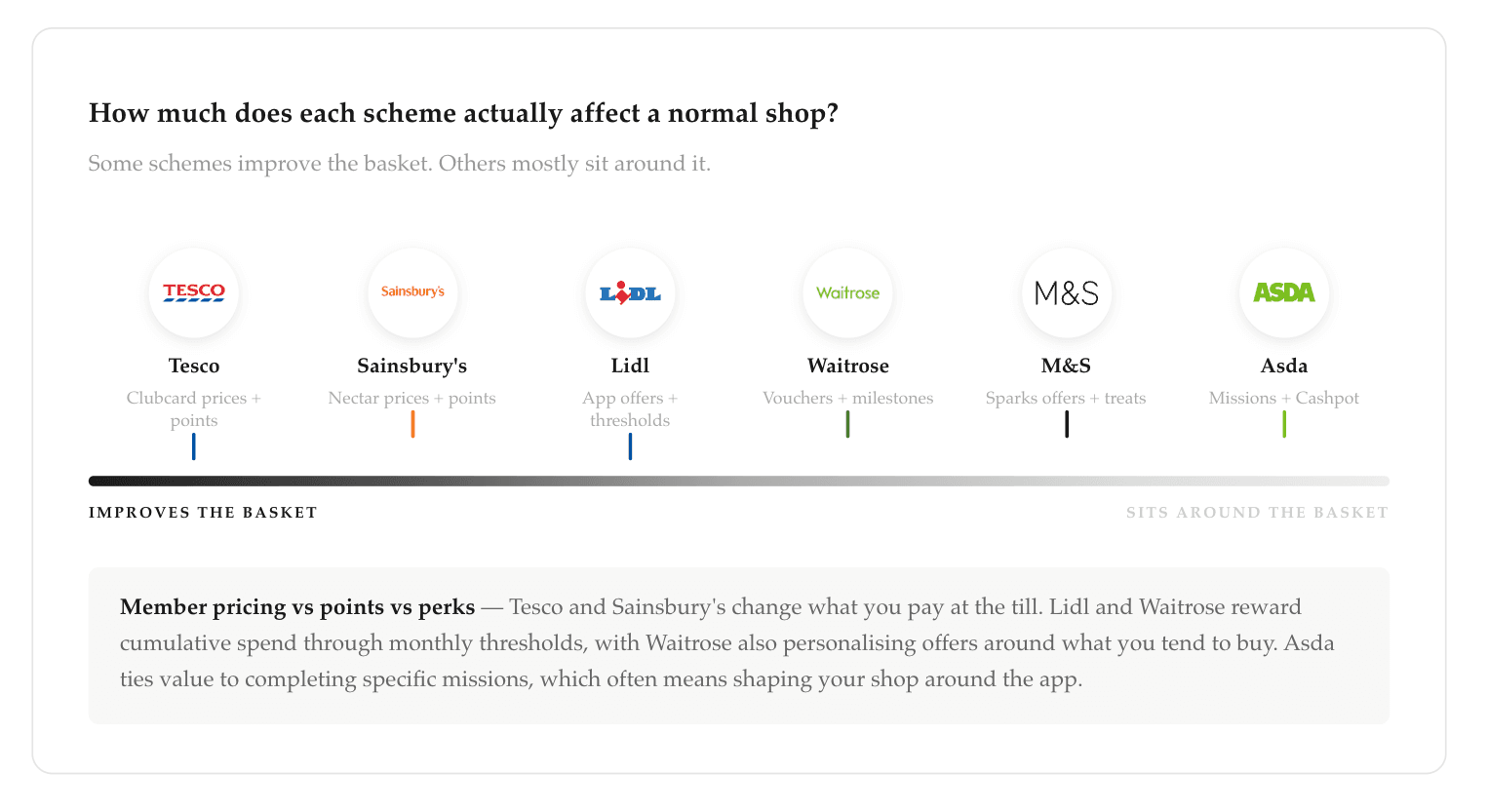
The key distinction: member pricing hits your basket today, you see it, you feel it. Points pay out later. Tesco and Sainsbury's do both. Most of the others operate in a more defined niche, rewarding behaviour, routines or engagement rather than the basket itself.
A basket-only comparison has its limits: several of these schemes aren't really trying to win that test in the first place.
The Shop - what was the experience actually like?
A loyalty scheme only matters if it fits the reality of the shop.
A loyalty scheme doesn't exist in a vacuum. If the shop is unpleasant, confusing, or forgettable, the card in your wallet isn't going to save it.
Tesco and Sainsbury's offered a familiar experience. Large, well-stocked, easy to navigate. The loyalty schemes fit naturally into the trip: scan at checkout, see the savings, move on. The best loyalty interaction is one you barely have to think about.
Waitrose requires a bit more planning. Personalised vouchers need to be preloaded in the app before you pay, which means you need signal or you need to have checked in advance. If you haven't loaded your offers, scanning the card doesn't do much for you in the moment.
Lidl also requires activating coupons in the app before you pay. What sets it apart is what you get for that effort: free bakery items, free fruit, tangible things you can pick up on the way to the till. The app interaction is similar to others, but the payoff tends to seem more consistent.
M&S had the strongest shopping experience of the six. Clean, spacious, well-lit, and the food looked genuinely high quality. Sparks offers do need to be loaded in the app before you pay, so the loyalty interaction requires some forethought, but the store itself does a lot of the work.
Asda takes a different approach. The Cashpot missions require you to adapt your shop to what the app is offering rather than the app adapting to what you tend to buy. At the time of our visit, the live mission was offering £1 for buying a slow roast beef joint, which may or may not be on your list.
A loyalty scheme isn't just competing on what it offers. It's competing on whether the customer will actually bother to use it.
What Came Back - did the scheme actually reward us?
You've done the shop. You've scanned the card. Now what? This is where the six schemes really start to diverge.
Tesco is the benchmark. Clubcard points compound across trips, and the 2x and 3x partner conversion routes are where it really pulls ahead: a few months of regular shopping can turn into a meal at Pizza Express or a cinema trip. That feels rewarding.
Sainsbury's runs a similar model, but the experience takes more work. Where Tesco neatly categorises partner rewards into 2x and 3x tiers, Nectar surfaces a mix of "collect 20 points per £1 here", "grab 9,000 points on this", "22,000 points when you do that", all at varying rates. You can get good use out of Nectar, but it requires more active navigation.
Lidl Plus doesn't give you points. It gives you app-activated coupons (free fresh fruit or bakery items with a £5 spend, percentage discounts), member prices on rotating products, and Coupon Plus, a monthly spend-threshold system that unlocks rewards like free bakery treats, free vegetables or free chocolate. Our basket cleared the first threshold. The rewards are small, but "free bakery item" lands harder than "16p in points" for most people. Their bakery is genuinely good, too.
Waitrose doesn't do points or cashback. Value comes through personalised vouchers, Little Treats at monthly spend milestones, and lifestyle perks: free coffee with a reusable cup, Big Cheese Thursday, Fish Friday, Sizzling Saturday. What Waitrose is really trying to do is become part of your weekly routine, a lifestyle partner rather than just a shop. Vouchers tend to be modest though, you have to preload them, and if you're not already a regular, the personalisation engine may not have much to offer you yet.
M&S Sparks offers personalised discounts based on what you actually buy, seasonal offers, a birthday reward (free Percy Pigs, because of course), a charity donation per scan, and preferential FX rates. It doesn't move the needle on grocery economics, but it feels genuinely meaningful if M&S is already part of your rotation.
Asda Rewards is built around Cashpot: complete missions to earn money that you can spend back at Asda. The individual amounts can be meaningful, but they depend on buying specific products. If the live missions happen to align with what you were already planning to buy, the value is there. If they don't, you're left with a choice between changing your shop to chase the reward or walking away with nothing from the scheme.
The real test of any loyalty scheme isn't whether it offers rewards. It's whether those rewards are strong enough to actually change where you shop.
The Loyalty Question - which schemes actually win us over?
Looking across price, experience and rewards, the six schemes were not all trying to solve the same problem. Some were trying to save us money. Some were trying to build habits. Some were reinforcing a shopping experience. These are not just different rewards. They're different theories of how loyalty gets created.
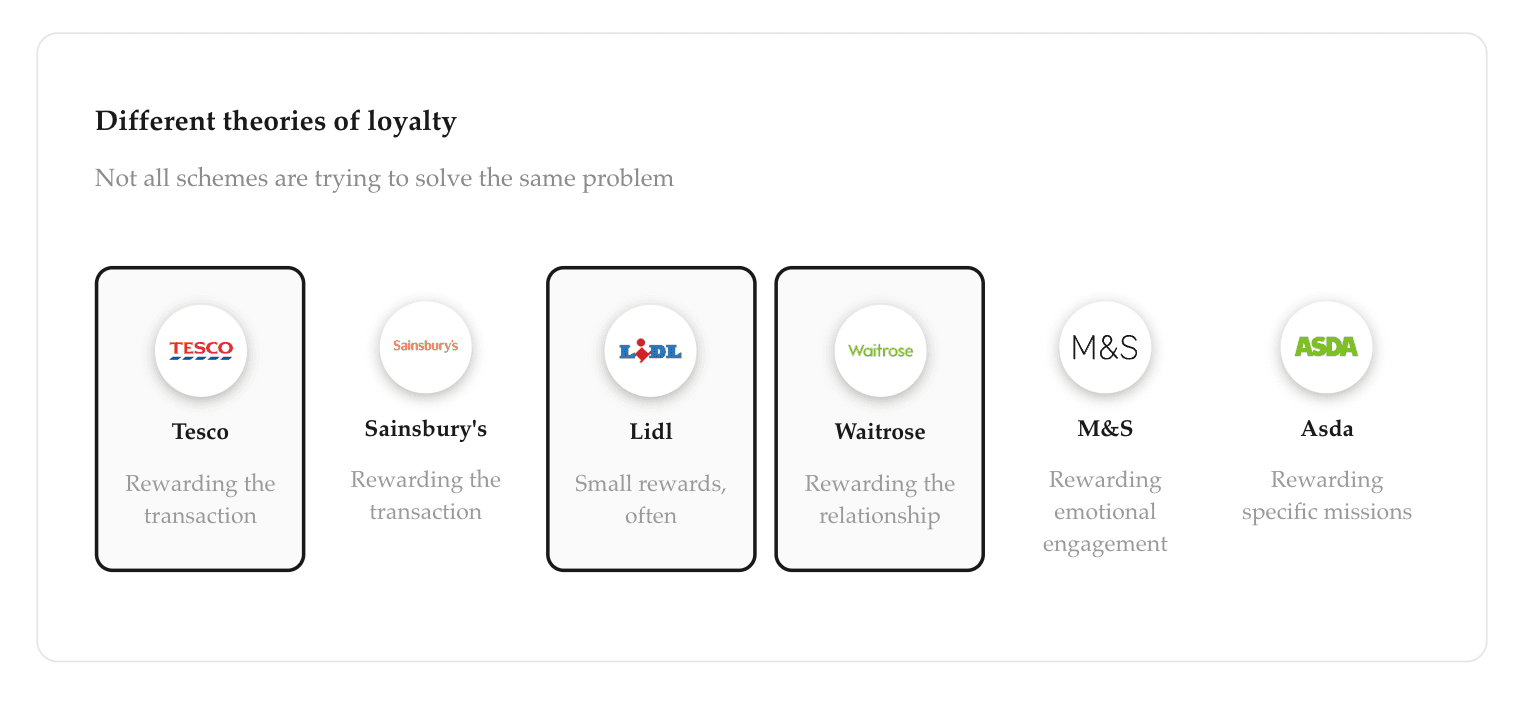
Once you see it that way, "who gives the most back?" starts to feel like the wrong question. The better question is: which approach actually works?
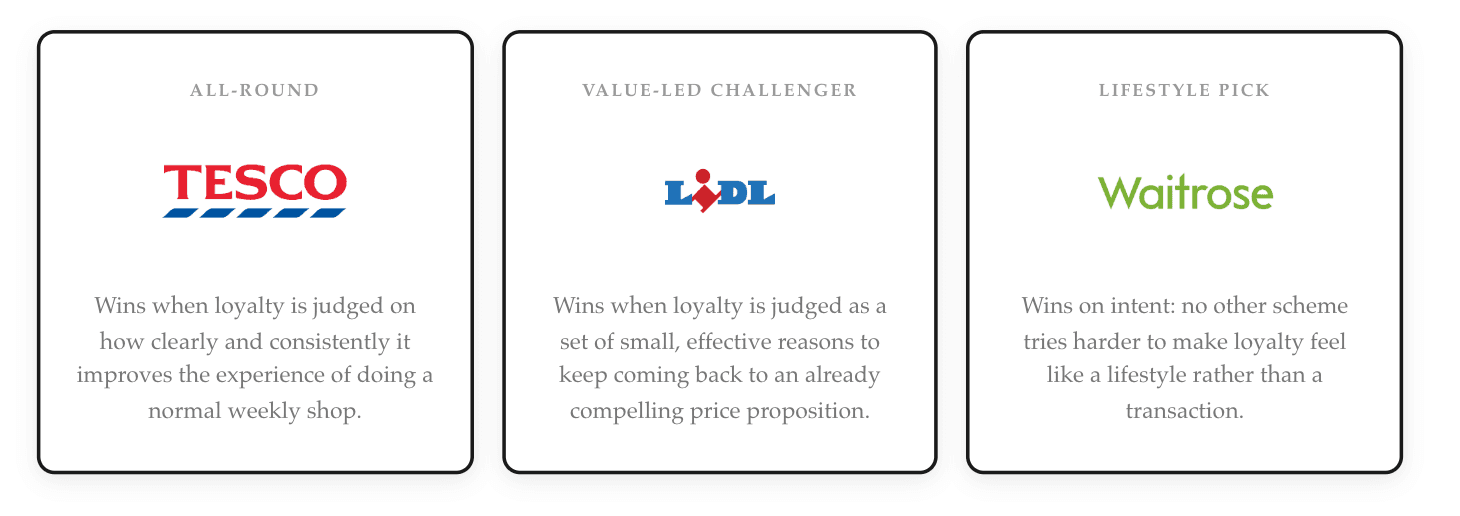
There isn't one winner here, because these schemes aren't all playing the same game.
The best supermarket loyalty scheme is not the one with the most points, the best app, or even the biggest rewards. It's the one that most convincingly gives you a reason to choose that shop again.