
Episode #1: Consumer Tech Napkin | Fundraising & Benchmarks in Consumer Tech
The conversation explores everything from customer love and community engagement to the growing influence of AI-generated content on social platforms, and what that means for founders trying to build authentic consumer brands in an increasingly noisy landscape.
🎧 Listen to the episode below.
Continuing the Conversation: The Metrics That Matter in Consumer VC
We've also published our latest blog to accompany our first episode: The Metrics That Matter in Consumer VC, where we explore the signals, KPIs and behavioural trends investors are paying closest attention to across modern consumer businesses.
This marks the first release as part of the True × EUVC partnership, with more conversations, founder perspectives and market insights to come.
Introduction
Let’s start with the bad news: there is no “one size fits all” when it comes to key metrics in Consumer.
That can make it scary for investors that are more at home with the alphabet soup of B2B SaaS metrics: annual recurring revenue (ARR), lifetime value (LTV), customer acquisition cost (CAC), net revenue retention (NRR), burn multiple, magic number, rule of 40, and so on. Consumer tends to be more nuanced and idiosyncratic - for many, a minefield not worth stepping into.
As a result, it’s harder to define a generic list of the ‘most important’ metrics for Consumer.
It will vary with sub-category (e.g. social vs. travel), business model (subscription vs. transactional vs. ad-funded), distribution model (B2C vs. B2B2C), and so on. For obvious reasons, comparing Robinhood to AirBnB on daily active user retention is nonsense, but they’re both worth ~$70bn at the time of writing. The devil, as ever, in the detail.
That said, we want to provide some guidance to Consumer entrepreneurs when it comes to metrics to be thinking about: not just as you head into fundraising, but as general health markers on your business. But first, a caveat: these are neither universally relevant (i.e. they do not apply to all businesses), nor universally valued (i.e. different investors view the world differently), nor exhaustive (i.e. they are not the only thing that matters).
The Questions Behind the Questions
Before diving into specifics, it’s worth outlining what we are trying to understand about a business through the lens of metrics. Fundamentally, we need to believe that the business:
Creates value for its user(s) over a sustained period of time
Has a plausible route to capturing value
Has an economically viable and scalable growth engine
Benefits from compounding advantages and defensibility over time and at scale
If all those things are true, we get excited.
Each of them can be mapped to a few example metrics. As with any metrics, all of the below are most powerful when shown in the context of benchmarks (we include some below - with a big h/t to a16z in particular), and/or historical trends. Metrics are also much more believable and valuable with significant sample sizes: ideally at least a thousand users as a rule of thumb.
Creates value for its user(s) over a sustained period of time
The best sign a product creates value is that a user engages with it.
For transaction-based businesses, the key measure of engagement is obvious: the customer transacts. For Consumer Tech businesses that are usage-based, it can be blurrier. We are typically most interested to understand how frequently and deeply users engage.
Metrics we like include:
DAU/MAU: daily active users as a percentage of monthly active users. This is a helpful read on regularity of engagement. Depending on the category and use case, we may look at WAU/MAU instead - for example, grocery shopping is not a weekly event, so it wouldn’t make sense to look at DAU/MAU. By contrast, Messaging and Consumer Social apps are daily by nature, so DAU/MAU should be higher on average.
Bryan Kim (a16z) provides helpful benchmarks for early-stage Consumer Social: 25%, 40% and 50%+ for OK, good and great, respectively.
Andrew Chen (a16z) similarly suggests >50% as the top benchmark.
Benchmarks from public companies: Facebook was 58% at IPO; Reddit does not disclose MAUs but DAU/WAU (which must be higher, by definition) was 27% at IPO; Roblox has been reported as ~20%. NB: Large company benchmarks are higher given network effects are established, so take these with a pinch of salt.
As an aside: be intellectually honest with your definition of ‘Active’. Is opening an app for 2 seconds really a sign of true usage?
L-ness: distribution of users by the number of unique days (or weeks) they were active in a given week (or month). This adds a further level of detail on how frequently a user returns to a product - a healthy marker of habit formation.
Kim (a16z) suggests 30%, 40% and 50% as OK, good and great for L5+ on weekly Lness (i.e. weekly users active on 5, 6 or 7 days per week). Remember, this is for Consumer Social so won’t be appropriate for less frequent use cases.
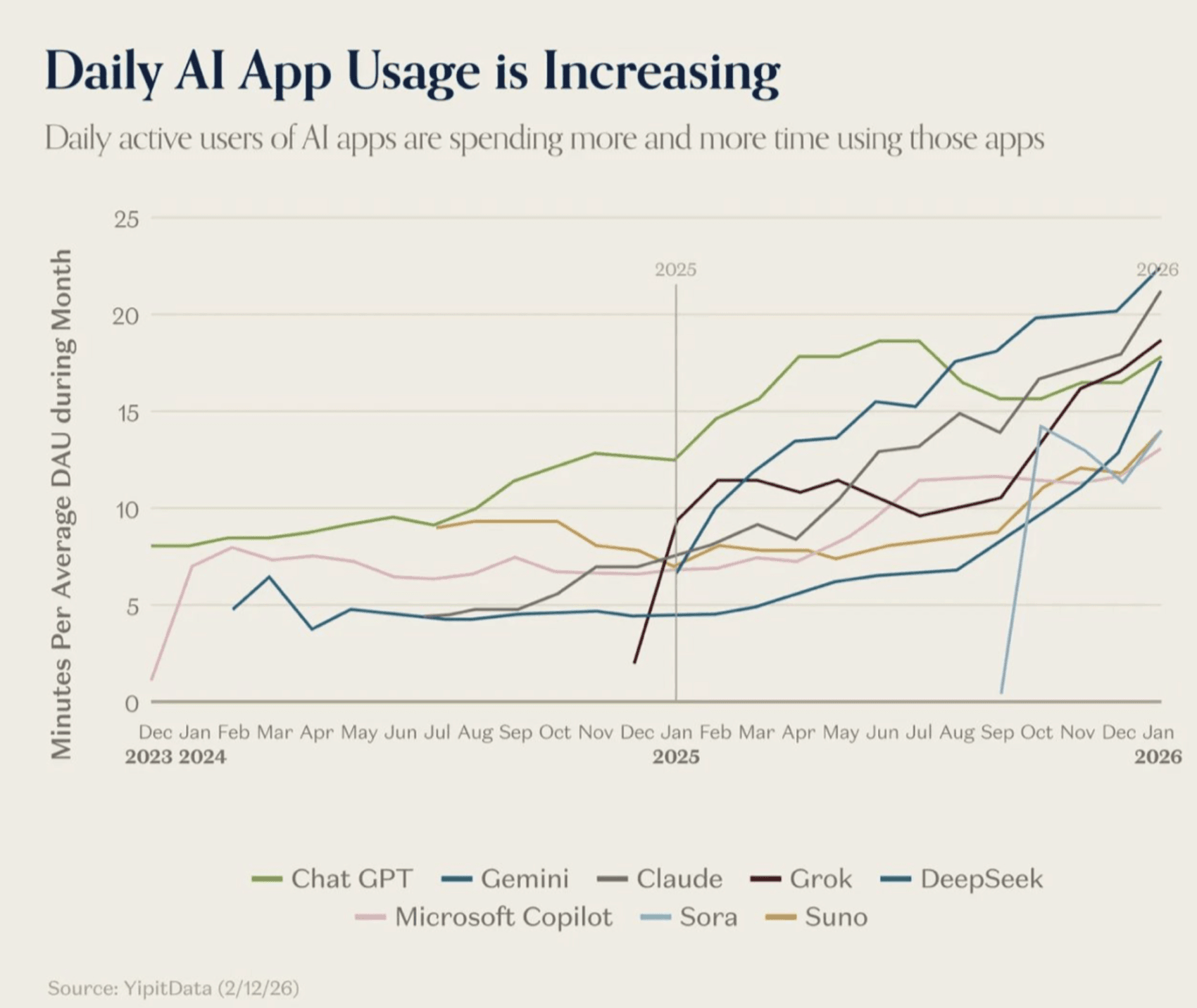
Usage duration: typically, average time per active user per day/session. We like this to understand depth, particularly with products designed to win users’ attention. Ideally this grows over time as users engage more deeply in the product (1):
Benchmarks from S-1s: Facebook was 20 mins at IPO, as was Reddit, Snap was 25-30 mins, Spotify was 50 mins, Roblox was 2.6 hours (!)
AI is picking up, too:
Events per session per user: the number of times the average user ‘does something’ that indicates product engagement in a given session. For example, this could be commenting, liking, posting, playing, and so on. This helps us understand both depth and breadth of product and feature engagement. Growth in this metric over time shows increasing average engagement - a great sign.
Example best-in-class: Snap boasted 18 app opens per day per DAU (!)
Net promoter score: This metric was developed in 2003 (pre-iPhone!) and has many flaws, but remains a helpful catch-all for assessing general customer satisfaction and has the added benefit of ultimate simplicity and objectivity in calculation.
Tom Blomfield (Monzo, YC) puts <50 as problematic and >80 great, but note that this can vary a lot based on sector and geography.
The second part of what we want is to see that this value to the user endures over a sustained period of time i.e. the customer interaction is not “one and done”. This shows up in retention metrics, which can come in a few different forms:
Bounded user retention (also known as “N-period” or “on” retention(2)): the percentage of a user cohort that uses a product on or at a specific time period (tn) after their first usage (t0). For example, D7 bounded retention counts only those users who come back on exactly day 7. Depending on the product, use case and age of the company, we focus on daily (D1/7/30), weekly (W1/4/12) and/or monthly retention (M1/3/6/12).
Lenny Rachitsky’s blog includes benchmarks for M6 user retention:
Consumer social: ~25% good; ~45% great
Consumer transactional: ~30% good; ~50% great
Consumer SaaS: ~40% good; ~70% great
Kim (a16z) offers benchmarks for shorter time horizons specifically for Consumer Social (ordered from OK to good to great):
D1: 50%, 60%, 70%
D7: 35%, 40%, 50%
D30: 20%, 25%, 30%
W1: 40%, 55%, 75%
W4: 20%, 30%, 50%
Chen (a16z) is roughly in-line with the above for ‘Consumer Tech’ more broadly, citing 60%/30%/15% for D1/D7/30.
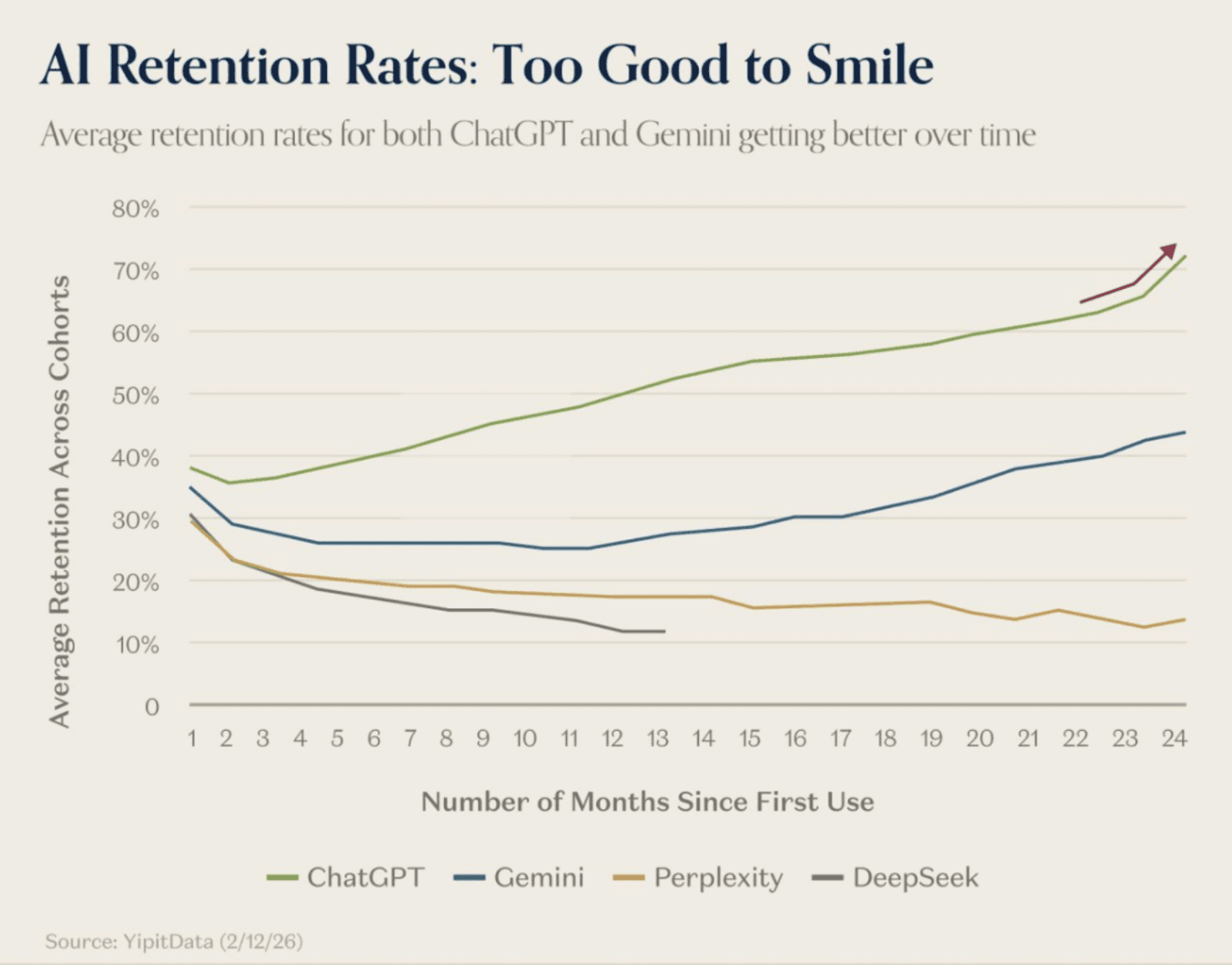
AI apps (at least ChatGPT and Gemini) are showing increasing retention over time - a sign of increased product utility:
Paid subscriber retention: the percentage of initial subscribers at t0 that are still active subscribers at tn, typically measured at intervals that match the billing cycle (e.g. weekly, monthly, annually). This can be more challenging with young companies that sell up-front annual subscriptions as there may not yet have been a churn opportunity. (3)
Rachitsky’s blog has benchmarks for M12 paid subscriber retention: ~55% good; ~80% great.
Chen (a16z) is in the same range, citing 65% as the target for annual retention.
Olivia Moore (a16z) shared some 2025 median benchmarks across AI and non-AI consumer businesses:
M1: high 70%s
M3: high 50%s
M6: mid 40%s
Check out the State of Subscription Apps 2026 from RevenueCat for excellent granularity of data on this and other helpful metrics.
Repeat rates: the percentage of new customers at t0 that have bought from the company again by tn (e.g. 6/12/24 months). Ideally this is framed in the context of the purchase cadence of the category itself to proxy whether the customer is loyal to the company or shopping around. This is most relevant for transaction-based businesses.
Plausible route to capturing value
User love is necessary but rarely sufficient.
At some point all businesses have to make money, and it’s here that many consumer businesses become unstuck. For us as an investor, the threshold of ‘proof’ around monetisation depends on the stage and type of company - and again, the devil is in the details.
Early on, there can be logic to pushing monetisation out on the time horizon. Introducing friction to user adoption can be counterproductive, for example if establishing network effects is important to the core value proposition (4) or if a steady flow of early user cohorts is required for rapid experimentation and iteration. By contrast, a single-player app in an established category has fewer excuses to defer monetisation.
This could be an entire blog post in itself, but to simplify to a basic rule of thumb: the stronger the logic for why monetisation should be deferred, the less scrutiny investors will place on it in an early-stage funding round.
A final point of context for the “value capture” discussion is the importance of contribution (revenue minus variable costs).
Revenue is a good marker of product value for a customer, but contribution is the ultimate driver of value creation for companies. Revenue growth and market size can be misleadingly flattering if the product is being sold at an uneconomic price: there will be infinite demand for a company selling £10 notes for £5. This focus on margins is an increasing topic of discussion in an AI era where the marginal cost to serve (inference) is higher than traditional software businesses.
There are some circumstances where low or even negative contribution margins can be acceptable, including where (i) variable costs reduce materially with scale (e.g. amortising large fixed costs over a larger user base); (ii) pricing power increases materially with scale (e.g. you have network effects); (iii) your beachhead product is a loss leader; and/or (iv) you have a capital advantage that can bridge you until competition fails and you have pricing power. Absent these, beware the allure of selling pounds for pennies.
With the above pre-amble and context covered, let’s move on to the specific metrics we look at to evaluate the health of a business that is monetising:
Average revenue per user: total revenue divided by total users, the most blunt force summary of how well the company extracts value from users. We love to see this growing over time as user value grows.
This is highly category and business-model dependent; search for benchmarks that align with your business and geography (US users are almost always the highest ARPU users, regardless of the business model).
Paid user penetration rate: the percentage of the user base that pays for the product (e.g. a paid tier of a freemium app). We look at this across the installed base as a whole and on new sign-ups to understand the ‘freshest’ data on willingness to pay
High single digits is considered strong here (see this post from Moore at a16z).
Check out the State of Subscription Apps 2026 from RevenueCat for detailed benchmarks for Day 35 Download-to-Paid ratios.
Contribution margin: revenue minus variable costs (but excluding marketing costs), expressed on a per-user basis and as a percentage of total revenue generated
Highly variable by business model and scale: 70%+ is great but also unrealistic for some business models depending on variable cost structures (e.g. Spotify for example is ~30%).
Lifetime value (“LTV”) / CAC: estimated value from a user across their entire lifetime based on customer retention (i.e. how many orders/months do I have the user for) and the contribution (not revenue!) earned per order/month, divided by CAC (see below).
3x is a rough benchmark but ‘the sooner the better’ e.g. 2x within 12 months.
Economically viable and scalable growth engine
The third broad area we want to assess is how the company will grow.
Fast growth is a necessary pre-condition for the venture-scale outcomes we are looking for and so it’s a key input into the underwriting criteria. That said, not all growth is created equal.
Organic growth - especially though word-of-mouth, referral and product virality - is typically better than paid growth. Paid marketing is not necessarily a taboo - Meta and Google are great enablers of direct-to-consumer and a big net benefit to consumer companies in general and start-ups in particular - but it can also drive flattering topline growth that can mask major flaws in the value creation equation. Existing customers passionately advocating your product to others is the gold dust that consumer businesses thrive on.
Here are the metrics we like to see:
User growth: most often measured week-on-week or month-on-month for early-stage companies. User growth is a relatively blunt force instrument that hides a lot of important detail, but nonetheless a helpful headline metric.
Paul Graham (YC) suggests 5-7% and up to 10% weekly growth is a go-to frame of reference. (5)
Kim (a16z) puts Consumer Social monthly user growth benchmarks at 20%, 35% and 50% for OK, good and great, respectively (weekly equivalents are 4%, 7% and 10% - tracking pretty closely to Graham’s numbers).
Blomfield (Monzo, YC) suggests a slightly slower rate of 10-15% monthly range for good-to-great (equivalent to roughly 2-3% weekly).
Chen (a16z) suggests 4x annual growth, equal to 3% weekly or 12% monthly.
Revenue growth: as above, but based on revenue growth rather than user growth. This obviously won’t be relevant if the business is pre-monetisation.
Broadly in-line with the above, with higher growth rates expected for smaller absolute numbers (it’s easier to grow 10x when your base is smaller…)
Organic as % newly acquired users: the percentage of new users acquired for free as a % of total newly acquired users in that period. Usually, the higher the better. This is particularly important for businesses pre-/early-monetisation, for obvious reasons.
Blomfield (Monzo, YC) says <50% is problematic, 80% is good, 100% is great.
Word of mouth coefficient: new organic users per non-organic user (returning users plus new non-organic users). This metric shows the extent to which existing customers drive new organic user acquisition (a higher number implies higher levels of referral activity). In our view this is a more helpful and generalised metric than the K-Factor, which is a more specific metric measuring efficacy of ‘invites’.
This Reforge blog is a great explainer and includes a couple of benchmarks.
Customer acquisition cost (CAC): marketing cost divided by acquired users. There are many nuances to the definitions here, but we prefer:
Numerator: total marketing cost including performance and brand marketing (often we see unusual or inconsistent categorisations of performance vs. brand marketing, so prefer to simplify) but excluding People costs
Denominator: users acquired via paid channels (often we see the ‘blended’ number across paid and organic user acquisition but this compounds variables in an unhelpful way for understanding underlying paid marketing efficiency)
CAC payback: the time it takes for your CAC to be repaid by contribution (not revenue). As a rule of thumb: the shorter the better as it means there is less sensitivity to LTV assumptions, and because it allows cash to be recycled more quickly into new growth making the business more capital efficient overall.
Rule of thumb: <3 months is great, <6 months is good, <12 months is OK
Benefits from compounding advantages and defensibility over time and at scale
Finally, we want to understand how the business gets more defensible over time.
There are a few ways defensibility compounds in Consumer.
A detailed walk through of these is beyond the scope of this article, but they include things like network effects (i.e. product value grows as the user base grows - see here for a great summary), scale economies (albeit hard to apply to a start-up, by definition), switching costs (i.e. it’s painful to move to a competitor) and brand.
At the early stages, many of these can be hard to prove out, and the nuance is so important that it’s difficult to be prescriptive on the exact metrics and analysis.
Rather than specific ‘new metrics’, usually the best way to show this is by cutting the above engagement, retention and monetisation metrics by different user cohorts. Cohorts can be based on time (i.e. “May 2025 users D30 is 5%pts better than January 2025 users”) or behaviours (i.e. “Users who connect with 5 friends have a DAU/MAU ratio 2x those that connect with 1 friend”).
The best case scenario is a compelling qualitative logic linked to the core insight into the problem you’re trying to solve combined with proof points that substantiate your initial hypotheses.
Pulling It Together
To pull back from the details, the most important thing is that metrics will only ever tell part of the story of whether or not a business has potential to deliver a venture-scale outcome. Particularly at the earliest stages, the data is often noisy, inconsistent and incomplete. Of course any investor will want to see numbers, but it will only ever be one input into their decision.
The final point is that we expect founders to have their own point of view on what metrics are important, and why. We want founders to be obsessed with the problem they are solving, and rigorously running experiments to figure out how to get the product or business ‘working’. For us, the sense that a founder is chasing arbitrary benchmarks simply to get a funding round closed is much less compelling that a founder that comes with solid hypotheses on why their product unlocks a new consumer behavioural paradigm, backed up with compelling data.
In other words, optimise for building a great business and the numbers (and capital) will follow.
Sources:
(1) From the Reddit S-1: “We generally find that the longer Redditors have been on Reddit, the more engaged they become. As of December 2023, when someone first makes an account, the average active minutes for logged-in users on Reddit starts at approximately 20 minutes per day, but increases to over 35 minutes a day for those who have been on Reddit for over five years and even over 45 minutes a day for those who have been on Reddit for over seven years.”
(2) Note: this should not be confused with “unbounded” (also known as “on or after”) retention, which is typically less informative.
(3) In this scenario we’ll look at usage retention as a proxy for value.
(4) Snapchat waited 3 years from launch to sell its first ad, at which time the user base was already over 50m users, though they did try other monetisation initiatives earlier on e.g. the Lens Store (source: Snapchat S-1). By contrast, Facebook started selling ads from year 1 and registered $9m in revenue in year 2, followed by $48m (!) in year 3 (source: Facebook S-1).
(v) Thanks to the magic of compounding, 5% weekly growth is 13x year-on-year!